Abundant Renewables, Constrained Thinking
Europe stands at a crossroads. It possesses some of the world’s richest renewable energy resources, a highly skilled industrial base, and a clear decarbonisation mandate. Yet it is failing to convert these strengths into competitiveness, productivity, or energy security. The reason is not technological. It is legislative inertia.
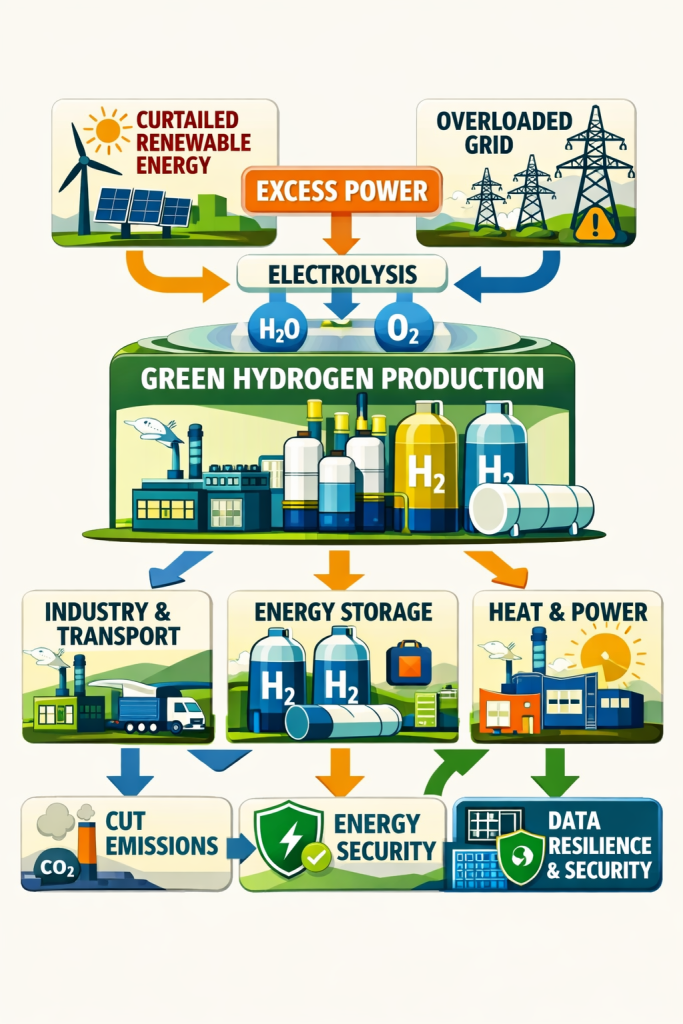
Across the continent, governments continue to treat the electricity grid as the only legitimate pathway for renewable expansion. The result is predictable: dispatch‑down, curtailment, and a chronic under‑utilisation of clean power. Instead of designing agile frameworks that allow renewables to flow into hydrogen, storage, flexibility markets, and industrial demand, Europe remains locked in a one‑dimensional mindset, build more grid, wait for more grid, depend on more grid.
Meanwhile, the world is not waiting.
The Cost of Legislative Caution
Europe’s reluctance to modernise its energy legislation is now a strategic liability. The EU’s own data shows that curtailment is rising, especially in regions with high wind penetration and slow grid reinforcement. Every megawatt-hour curtailed is a megawatt-hour of lost competitiveness.
Yet governments continue to legislate as if the grid is the only system that matters. Hydrogen, flexibility markets, and sector coupling remain afterthoughts — discussed enthusiastically, implemented hesitantly, and regulated slowly.
This is not a technical problem. It is a policy problem.
The Productivity Warning Europe Cannot Ignore
Economist Paul Krugman observed that “productivity growth has been lower during the digital era than it was after the Second World War, a period without breakthroughs.” Europe’s stagnation is even more pronounced. While the US has surged ahead in productivity, innovation, and clean‑tech investment, Europe has become slower, more cautious, and more fragmented.
China, meanwhile, is accelerating rapidly scaling renewables, electrolysers, storage, and industrial hydrogen applications at a pace Europe cannot currently match.
The global race is no longer about ambition. It is about execution.
Curtailment: Europe’s Untapped Competitive Advantage
Curtailment is often framed as a problem. It is an opportunity, if Europe chooses to seize it.
Curtailment represents:
- Surplus renewable energy already built and paid for
- Zero‑carbon electricity available at marginal cost
- A buffer that can be converted into hydrogen, fuels, heat, and industrial feedstocks
- A mechanism to relieve grid congestion without waiting for new lines
Hydrogen is not a silver bullet. But it is the only scalable vector capable of absorbing large volumes of curtailed renewables and converting them into system value.
Europe’s failure to legislate for this is a self‑inflicted wound.
Agile Legislation: The Missing Ingredient
What Europe needs is not another strategy document. It needs legislative agility — frameworks that move at the speed of technology, not the speed of bureaucracy.
This means:
- Allowing flexible hydrogen production during periods of surplus renewables
- Creating market signals that reward system value, not just electrons delivered to the grid
- Enabling local energy ecosystems where renewables, industry, and storage co‑develop
- Reducing the regulatory friction that slows down hydrogen projects
- Recognising that grid expansion alone cannot deliver energy security
Europe must stop treating hydrogen as a future option and start treating it as a present necessity.
Competitiveness Is Now an Energy Issue
Europe’s productivity challenge is inseparable from its energy challenge. High energy prices, slow permitting, and rigid regulation are eroding industrial competitiveness. The US has the Inflation Reduction Act. China has scale and speed. Europe has ambition but ambition without agility is not a strategy.
If Europe continues to rely solely on grid expansion, it will fall further behind. If it unlocks the full potential of renewables through hydrogen and flexibility markets, it can regain momentum.
The choice is stark, and the window is narrowing.
Conclusion: Europe Must Act Like a Contender, Not a Cautious Observer
Europe has the resources, the talent, and the industrial base to lead the global hydrogen economy. What it lacks is the legislative courage to move beyond a grid‑only mindset. For the first time in years, however, the policy fog is beginning to lift.
The European Commission is now reviewing the Delegated Acts and RFNBO rules, acknowledging what industry has long argued: the current framework is too rigid, too slow, and too disconnected from real‑world renewable conditions. In parallel, the UK’s Department for Energy Security and Net Zero (DESNZ) has launched a Call for Evidence on Flexible Electrolysis, signalling a shift toward system‑wide thinking — where hydrogen is recognised not as a future add‑on, but as a core flexibility asset.
These developments matter. They show that policymakers are finally confronting the structural barriers that have constrained renewable utilisation and suppressed Europe’s competitiveness. The mist is clearing. But clarity alone is not enough.
Europe must now act in cohesion, aligning EU and UK frameworks, harmonising definitions, accelerating permitting, and enabling hydrogen to operate as a real‑time buffer for renewable energy. Fragmentation is the enemy of scale. Caution is the enemy of competitiveness.
If Europe continues to legislate slowly while the US deploys capital at speed and China industrialises at unprecedented scale, the gap will widen. But if Europe embraces agile regulation, unlocks curtailed renewables, and builds a hydrogen system that complements, rather than waits for the grid, it can reclaim its position as a global leader in productivity, innovation, and clean‑energy industrialisation.
The opportunity is here. The signals are emerging. The question is whether Europe will move with the urgency of a contender or the hesitation of an observer.
Hydrogen Ireland: Shaping the Conversation, Driving the Transition
As Europe moves toward a more flexible, integrated, and hydrogen‑enabled energy system, Hydrogen Ireland is actively shaping these discussions — providing evidence, convening expertise, and supporting policymakers and industry as they navigate this pivotal moment.
With Ireland assuming the Presidency of the Council of the European Union from July to December 2026, Hydrogen Ireland is preparing a coordinated programme of webinars, workshops, and our annual international conference to align with this milestone and amplify Ireland’s hydrogen message to a global audience. This programme is designed to bring clarity where uncertainty remains, to build cohesion across sectors, and to ensure that Ireland’s voice is heard in Europe’s evolving hydrogen framework.
Hydrogen Ireland 2026 Programme
- 2nd July — Webinar Clean Hydrogen: Not at All Costs, Not at Any Cost — but at the Right Cost
Host: Pinsent Masons A deep dive into cost‑competitiveness, system value, and the emerging policy frameworks that will define Europe’s hydrogen economics.
Registration – Microsoft Virtual Events Powered by Teams
- 26th August — Webinar Hydrogen’s Role in Delivering Electricity Security of Supply for Ireland
Host: ESB Exploring hydrogen as a strategic asset for resilience, flexibility, and long‑duration storage in an increasingly renewable‑dominated system.
3. 10th September — Webinar Beyond the Grid: Clean Hydrogen Pathways for Data Centres
Host: Bord Gáis Energy Addressing one of Europe’s fastest‑growing energy challenges — data‑centre demand — and the role hydrogen can play in enabling secure, low‑carbon digital infrastructure.
4. 14th October — Workshop Hydrogen Ireland 2026: Delivering Demand, Security and EU‑Aligned Deployment
Host: Gas Networks Ireland A technical and policy workshop focused on aligning Ireland’s hydrogen deployment with evolving EU frameworks, including the review of the Delegated Acts and RFNBO rules.
5. 18th –19th November — International Conference H₂ SUMMIT 2026: Securing Europe’s Energy Future — Hydrogen for Energy, Industry and Data Resilience in a Connected Europe
Host: Hydrogen Ireland the flagship event of Ireland’s EU Presidency year — convening European policymakers, funders, system operators, and global industry leaders to chart the next phase of Europe’s hydrogen transition.