Hydrogen: the green crude of our future…
As countries outline their plans for hydrogen to play a pivotal role in our sustainable future and more and more hydrogen projects go ahead, the global need for sustainable hydrogen increases rapidly. These same countries are rapidly understanding that there will be a need to trade hydrogen across the globe. Regions that do not have sufficient renewable energy resources will find it hard to produce bulk amount of green hydrogen for large scale infrastructure developments locally. Some countries, such as Portugal and Spain, have an excess of renewable energies available which, when coupled with scaled-up electrolysers, could produce significant green hydrogen. Plans are being developed for it to be exported to other regions of Europe, whilst also being used locally. These projects are looking at how to couple energy supply and demand and use the shipping of hydrogen as the transfer mechanism for the energy import and export thereby enabling best and most cost-effective use of renewables across all regions.
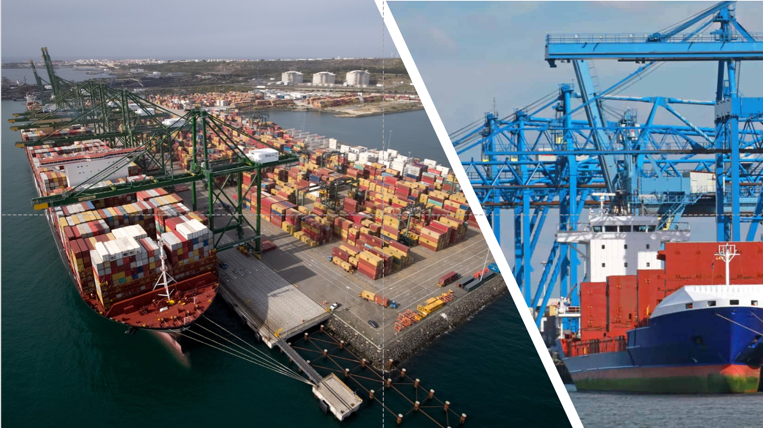
One such project is the previously mentioned production of green hydrogen in Portugal. The Netherlands and Portugal are in talks to build a hydrogen production plant in Sines, powered by a GW of solar PV. The total project could cost up to €3.5 billion, but upon completion, is predicted to be able to supply cheaper electricity than from more conventional methods as the renewable electricity will be exempt from grid access tariffs. Sines has already identified public land ready for use, designated for industrial projects, further decreasing initial cost. Once the hydrogen is produced, it will be shipped to the port of Rotterdam, Europe’s largest port. Here it will be combined with locally produced green and blue hydrogen and used to deliver Rotterdam’s hydrogen strategy: decarbonisation of local industrial processes together with the trucks, buses and barges that transport the port’s cargo and people as well as providing power to heat local homes. Any excess will be spilled into the proposed Netherlands national hydrogen grid, to power other locations in the country. There is also the possibility of further exporting to other regions of Europe either at sea or through the Rhine-Alp corridor.
Many other countries in Europe have insufficient renewable energy capacity when compared to their energy consumption, which will also grow as we decarbonise mobility and heating, and will need to strongly rely on imports. Germany for instance, has significant hydrogen usage in their decarbonisation strategy and will need to import on a large scale. To that end the country has signed an agreement with a number of African nations to explore hydrogen value chains together.
Looking further afield, Japan has recently become the first country to build a liquid hydrogen carrier ship, named “Suiso Frontier”, Suiso being the Japanese word for Hydrogen. Produced by Kawasaki Heavy Industries, the 8,000 tonne vessel was launched in Kobe back in December 2019 to a crowd of over 4,000 people. The vessel is undergoing trials and is scheduled to be fully completed in late 2020 but is subject to some delays due to Covid. The vessel will run between Japan and Australia, with trial shipments beginning as early as March 2021.
Japan, like Germany, understands it needs to secure future sustainable energy supplies. Their historic reliance on nuclear power, undermined by the Fukushima disaster and a growing environmental assertiveness of their populations, has accelerated this need. In the region Japan is not alone in its need for energy import to maintain its economy – China and South Korea lead a long list. Australia, and its neighbours, see this as a massive opportunity for a complete new growth sector – with estimates by CSIRO expecting 3.8 million tonnes being produced by 2030, costing upwards of $9.5 billion.
With countries on the road to decarbonisation, the increasing import and export of hydrogen is inevitable. As production methods scale and hydrogen economies/value chains emerge throughout the world, supplying and shipping via these hubs will become more economic. These will enable our sustainable future. No wonder German minister’s are calling hydrogen the green crude of the future…
By Ian Williamson