Can the ITEG project catalyse tidal energy to hydrogen?
Jack Kincade of HyEnergy Consultancy takes a look at the project, its aims and what success could mean for the sector…
ITEG – Integrating Tidal Energy into the European Grid. An acronym that stands for much more than just the words that make it up. It stands for ingenuity too; the ingenuity of the problem solvers that looked at a, frankly, disparaging future for tidal energy and saw solutions (and progress) through hydrogen integration and improvements on the turbine technology. ITEG, therefore, also stands for hope. Hope in a future where we have tidal energy as another resource in the fight against global warming.
We need this hope too, because things aren’t too great right now. Yes, work is being done on meeting global CO2 reduction rates, but it isn’t enough… yet. There has been success in reducing 2020 CO2 emissions by 20% vs 1990 levels, however, to reach the Paris Agreement goal of carbon neutrality by 2050, an increase to 55% is necessary by 2030, at the latest. More work needs to be done. More solutions are needed.
Throughout its history North West Europe (NWE) has been themed by the sea. Fish and Chips, pickled herring, moules-frites, oysters. Pirates, Vikings, settlers, fishermen. This is all history that has formed the fabric of NW European culture, now, we look to the sea to form a large part of its future, through marine energy. The EU strategy on Offshore Renewables places offshore wind farming as the cornerstone technology to meet their targets, with a desired 300GW capacity by 2050.
But, of course, offshore wind isn’t the only offshore renewable. Let’s not sleep on tidal energy…
There is massive potential in tidal energy. Around the British Isles particularly, there is a huge amount of tidal activity. The Severn Estuary showcases the world’s second highest tidal range of 50ft, the UK is able to boast the largest marine energy potential in Europe, as well as a rich tidal history with the world’s first commercial tidal turbine in Strangford Lough, County Down. The theoretical, the tidal energy resource around the UK is estimated to be worth approximately 216 TWh/year. Indeed, the UK government estimates that approximately 20% of their energy demands could be met by tidal energy.
If this is the case, what’s the hold up? Why aren’t we seeing the same momentum we are in wind and solar with tidal? The answer is cost. Demonstrations of tidal energy are too costly making it difficult to prove the feasibility of the technology to potential investors. Companies have tried, and failed, to do so in the past, which has stalled progress and disrupted technology continuity. This explains, at least on behalf of the share attributed to tidal, why the IEA have classified marine energy as ‘not on track’.
So, we need a demonstration of the feasibility of tidal energy to hydrogen… which is the overarching aim of ITEG. More specifically the project will:
- Use hydrogen production and energy storage to demonstrate options for future market openings for the ocean energy sector
- Optimisation of an Energy Management System (EMS) in order to drive methods to generate, manage, and store clean energy closer to commercialisation
- Gain experience on risk reduction for future projects
- Build a roadmap for future implementation of integrated systems in remote areas
The intended outcome is to provide confidence and solutions for both the industry and investors in proving that tidal energy is fit for purpose and ready to take its place in the renewables to hydrogen race we have all embarked on. Three key technical elements will be deployed:
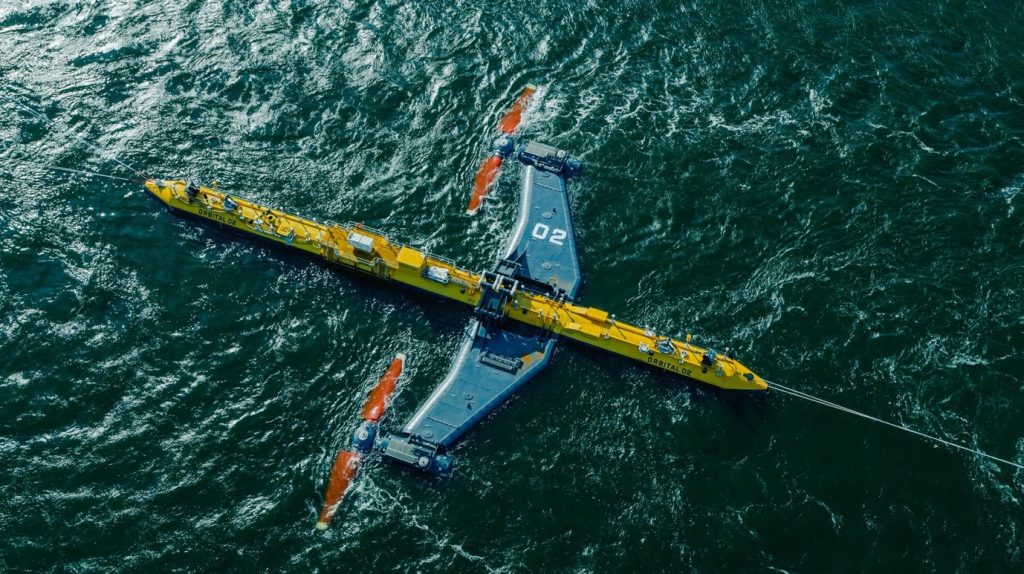
- the Orbital Marine Power’s O2 2MW Tidal Turbine
- Elogen’s scalable PEM Electrolyser
- EMEC’s new renewables EMS
These three novel technologies are united to create a system where the main flaw of tidal energy and renewables in general, i.e. its lack of continuous energy production, is mitigated by the hydrogen electrolyser.
Orbital’s O2 2MW was launched on April 22nd, 2021 as the world’s most powerful tidal turbine. It’s an awesome display of engineering, creating a 73-metre, space-aged looking, floating vessel with two ‘gullwing arms’, attached to which are two rotors with a diameter of 20 metres each, producing 1MW respectively at a tidal current speed of 2.5m/s. Currently, it is situated at EMEC’s Fall of Warness tidal test site, just off the coast of Eday in the Orkney Islands, ready for commissioning within the ITEG project.
The tide lasts on average 12 hours a day (6 hours for each tide), which means that the turbine is only producing energy 50% of the time. Needless to point out, this isn’t constant. This poses issues: if there’s a fluctuating amount of power within the grid, at best you have flickering lightbulbs, at worst you may have system collapse. So, enter Elogen’s PEM electrolyser. EMEC’s EMS will monitor the energy output from the turbine and determine how much energy should be diverted to the electrolyser, instead of the grid, at which point this ‘excess’ energy is converted into hydrogen and stored. The hydrogen will be used for hydrogen applications being developed all over Orkney – from shore-to-ship power to vehicles.
It is the intended goal that these three systems working in near perfect harmony will clearly demonstrate the value of hydrogen integration into tidal energy; revitalising tidal energy as a tool against climate change.
We believe hydrogen is the solution for the re-emergence of tidal energy as a significant renewable energy vector. By the time ITEG has come to a close, December 2022, this should be all too obvious. It will be ready to take its place alongside the existing mainstream renewable energy production methods and accrue the same benefits from entering into a relationship with hydrogen.