It is widely agreed that climate targets will only be realised if all sectors contribute to their achievement, only combined action will achieve the results the world needs.
In Ireland, Renewable Energy implementation in combination with trans sectoral energy efficiency measures has led the way. However, improvements have largely come from the public sector and energy suppliers delivering on the energy efficiency obligation scheme, a remarkable achievement. On the review of the 2018 Energy Efficiency Directive, it provided options to waive targets for certain sectors, including transport in the reduction calculations, this could lead for Governments excluding these sectors when allocating targets. To ensure there is equal sharing and commitment across all sectors we believe the role of transport should be an integral component to delivering change and the transport sector should not be excluded from climate obligations.
Transport remains the largest energy-consuming sector in Ireland for example (and is similar across the EU), with a 35.4% share of primary energy in 2018, and a 42% share of final energy. Although the sector has been making great strides for example; it’s primary energy use fell by 28% between 2007 and 2012 however, this has increased by 25% since then. Transport has the largest share of primary energy, accounting for 35.4% in 2018 (5,197 ktoe), followed by heat at 33.5% (4,940 ktoe) and electricity at 31.2% (4,562 ktoe)3. Note; where thermal or transport energy is provided by electricity (e.g. electric heaters and electric vehicles) this energy is considered under electricity, and not under thermal or transport.
There is a need to widen the participation in obligation schemes to ensure a broader group of parties are obligated and that an increase in targets does not fall on one sector. As Transport has the largest share of energy consumption there is a need for transport to be in the driving seat and get into the fast lane by delivering on Zero Emission Vehicles increasing energy efficiency on all areas of the transport infrastructure.
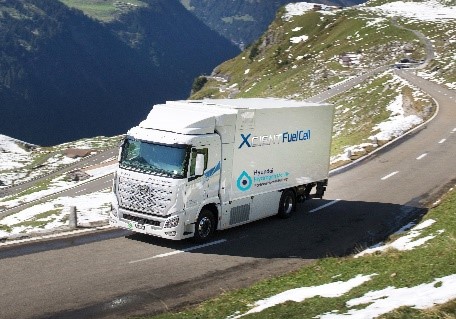
We in H2IRL believe that Hydrogen can play a key role in delivering the Transport Climate Targets whilst also delivering on jobs, business opportunities and improve air quality. HGV freight is one of the hardest sectors to decarbonise; however, with a Fuel Cell Solution zero emission can be achieved. This off course will not be easy; it is essential that the key areas are addressed to deliver zero emission lorries and infrastructure.
It will require in-depth planning, design and projects for a future large-scale freight demonstration including; Electric Charging Infrastructure, Hydrogen fuel cell, Hydrogen Refuelling Stations and zero emission Supply chain for road freight
The benefits for businesses of all sizes (micro, SME and large), Academia and Government is enormous but will only be achieved if we work together in a coordinated and strategic way. At Hydrogen Ireland we are keen to bring all the key players together to discuss and develop solutions including; HGV and truck OEMs, Transport and logistics operators, Local authorities, Academic Institutions, Roads Authorities, Energy providers, Regulators, Infrastructure providers, Power Engineering and Data Providers.
Green mobility as a solution for our fossil fuel dependence is not just a case of electric versus hydrogen vehicles. Our mobility of the zero-carbon future will be a hybrid solution of electric cars dominating short commuter runs and light transport, with H2 Mobility providing a green solution for trucks, buses and trains. Hydrogen vehicles emit only water vapour and warm air and so widespread adoption in heavy goods vehicles would avoid emissions of harmful nitrogen oxides (NOx) and particulates, which can impact on human health.
“With longer running distances, payload returns and faster refuelling, hydrogen is perfect for HGVs, buses and trains. Hydrogen in these transport sectors will help improve air quality in our cities helping contribute to our Paris Agreement obligations’ Mark Welsh Energia
For further information and discussion please do not hesitate to contact Hydrogen Ireland at https://hydrogenireland.org/contact/
Mark Welsh
Hydrogen Ireland Board Member