Do hydrogen trucks hit the fuel cell sweet spot?
By Ian Williamson
Truck OEMs have historically ignored hydrogen as a possible fuelling method. Even after demonstration projects of vans and busses, they have not been inspired to focus efforts on the commercial vehicle sector. Some US OEMs did react to specific opportunities, such as ports with retrofit developments, however, European OEMs became dormant.
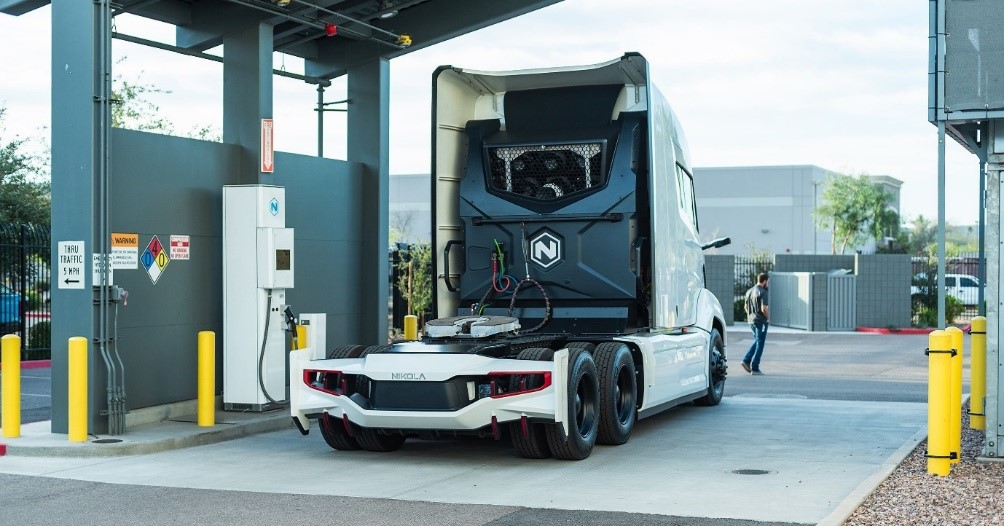
This all changed with the hype surrounding Nikola. Similar to Tesla for the battery market, since its formation in 2016, Nikola has been PR led, issuing positive sustainable trucking soundbites and mirroring Tesla’s approach. That being, infrastructure is not an issue as they will also deliver it. This has advanced development of models which in turn is driving investment in the company with Bosch, GM an Iveco, amongst others becoming major shareholders. Nikola have a more outsourced approach to manufacturing than Tesla, enabling such companies to see the potential of future partnerships.
This has kick started the reaction of many OEMs. Hyundai have led in the European market, and other truck OEMs are following suit in the coming years with hydrogen fuelled models. Hyzon has established itself in Europe by taking over Holthausen’s retrofit FC business, whilst Toyota is also positioning for its share of the market. Daimler, Europe’s largest truck manufacturer have announced the ‘GenH2 Truck’, which they aim to be able to achieve a range of 1000km, which they say is essential to its development. This will be possible with an onboard storage of 80kg of liquid hydrogen – the first truck is planned for a 2023 delivery.
Similarly, European funding has changed to suit heavier mobility applications, allowing hydrogen infrastructure and vehicle OEMs to agree on a specific target market for a hydrogen roll out. Countries and cities have also seen the potential in zero emission transport and see hydrogen as a viable option for HGVs, larger vans and busses. Goods vehicles currently account for 30% of emissions from most EU countries fleets so hydrogen infrastructure becomes increasingly supportable with public funds.
Back to today’s EU FC truck leader, Hyundai. They have collaborated with swiss company, H2 Energy, to supply hydrogen trucks to Switzerland. Hyundai aim to deploy 50 trucks by the end of 2020 and 1,600 by 2025. H2 Energy will then lease the trucks to commercial operators on a pay-per-use basis. As this requires no initial investment from commercial customers, it entices use from those who would not usually invest in full scale deployment of hydrogen infrastructure. The hydrogen supply will come from local company, Hydrospider, who has Linde as a 10% shareholder. An historically high fossil taxation regime should see a swift uptake and deployment in the region.
The Hyundai truck itself is the world’s first mass-produced fuel cell heavy-duty truck, branded the ‘XCIENT’, and was publicly launched via Hyundai’s Youtube last week. The FC is equipped with 7 x 350-bar hydrogen tanks that provide 32kg of hydrogen and a c.400km driving range. There are two 95kW fuel cell systems combined with a 72kWh high voltage battery and a 350kW E-motor. The truck has a GCW of 36 tons and can be equipped with an extra trailer.
Reacting to this, several European companies are putting together the concept of a ‘hydrogen corridor’ for FC trucks in the Netherlands, Belgium and Germany. The consortium was put together by the Port of Rotterdam and features partners from across the whole value chain, including OEMs VDL Groep, Iveco/Nikola, with the target of deploying 1,000 trucks. Investment decisions will be made by the end of 2022 at the earliest.
Although the initial uptake was slow, there is significant change coming to the trucking industry. First steps in mass production and roll out projects are occuring. Maybe FCEVs have found their sweet spot at last….?